What the screener finds, and what it misses

Screens are useful, but only if you treat them as triage rather than truth. A good screen does not tell you what to buy. It tells you which companies deserve a valuation, which ones belong in the "be careful" bucket, and which ones look cheap only because the business is deteriorating.
That is the right way to read this Koyfin output.
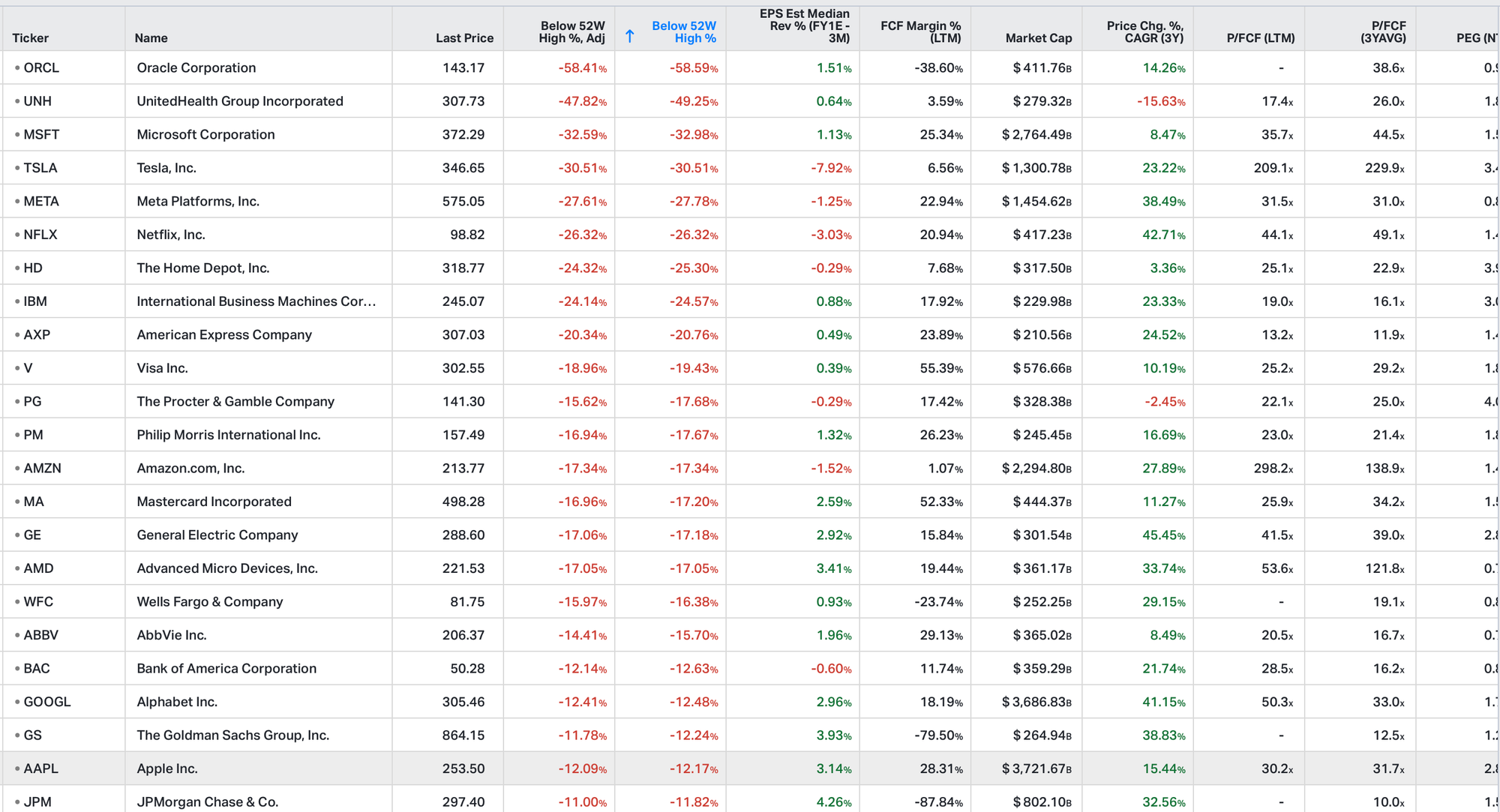
The sample is small, but it is still enough to make one point clearly: cheapness by itself is not a virtue. A low multiple can reflect mispricing, but it can also reflect leverage, cyclicality, weak business quality, or a market that has already figured out the story.
The Most Useful Part of the Screen
The strongest part of the framework is not any single ratio. It is the interaction between cash flow, growth, margins, and leverage.
Take Verizon.
On a superficial screen, both look attractive. Their FCF yields are high, their EV/EBITDA multiples look low, and their earnings-based valuation does not appear demanding.
If you stopped there, you could easily label them bargains. But once revenue growth and leverage are brought back into the picture, the illusion fades.
These are highly levered businesses with little to no growth. They are statistically cheap, not obviously underpriced.
That is a distinction investors often miss. There is a difference between a good business that has become cheap and a challenged business that always looks cheap.
The screen also does a good job with Dell and Exxon. Both would survive a simple low-P/E filter. Neither looks especially expensive on first pass.
But gross margins force you to confront business quality. Dell's thin hardware margins and Exxon's commodity economics are not bugs in the data. They are the business model. A low multiple on a structurally low-margin business is not automatically a margin of safety.
Why Cash Flow Helps, but Does Not Finish the Job
If I had to pick one starting point in the screen, it would be FCF. It is usually harder to manufacture than earnings, and it often gives you a cleaner read on what a business can return to investors.
That is why names like CRM, BKNG, and PDD stand out. Their cash flow metrics are strong, and unlike the telecom names, they are not paired with obvious operating stagnation. In other words, the cheapness is at least accompanied by business momentum.
But even here, caution is required.
PDD may be the most statistically attractive company in the table, but the screen has no way of pricing governance, regulatory, and geopolitical risk. Those risks are not side notes.
For a Chinese company with a VIE structure, they are part of the valuation. A clean ratio table cannot rescue you from country risk.
BKNG looks strong as well, but its historical growth rate benefits from a pandemic-distorted base. That does not make the company unattractive. It simply means that the growth input should not be carried uncritically into a valuation model.
In other words, the screen gets you to the right room, but it does not close the investment case.
Where the Ratios Start Breaking
The biggest mistake investors make with screening is assuming all sectors can be squeezed through the same template.
The gold miners are the cleanest example.
Newmont and Agnico may look appealing on some multiples, but their earnings, margins, and even growth rates are functions of gold prices, reserve changes, and acquisition timing. A PEG ratio built on analyst earnings estimates may look precise, but it is false precision.
These are assets-in-the-ground businesses. They should be valued with a net asset value framework, not treated like software or healthcare companies.
Return on equity also breaks more often than investors admit.
AbbVie, Booking, Dell, and HCA all remind us that book equity can become distorted or even negative after buybacks and capital structure decisions. When that happens, RoE can move from informative to absurd very quickly. A spectacular RoE is sometimes evidence of business quality.
At other times, it is little more than an accounting artifact. This is why screening should always be tied to first principles. Ask what the company does, how it makes money, what reinvestment it requires, and what risks the ratios are unable to see.
The Names Worth More Work
If the purpose of the screen is to decide where deeper valuation work belongs, three buckets emerge.
CRM and BKNG look like the cleanest candidates for more work. They combine reasonable valuation with business quality, growth, and manageable balance-sheet risk.
PDD, GILD, and TMUS are more conditional.
PDD has the strongest raw numbers but also the largest non-financial risk. Gilead is profitable and cash-generative, but the growth profile is weak enough that any valuation has to be driven by pipeline judgment rather than historical comfort.
T-Mobile has a better operating story than the older telecom incumbents, but leverage remains a real constraint.
The rest fall into two familiar groups: businesses that need a different valuation template, such as the miners, and businesses that look optically cheap but not obviously mispriced, such as Verizon, AT&T, and Exxon.
Bottom Line
The screen is doing what a good screen should do. It is not producing a buy list. It is separating companies into three categories: businesses where valuation work may pay off, businesses where the cheapness is probably structural, and businesses where the framework itself is the wrong one.
That is progress.
The danger comes when investors ask a screen to do more than it can. Ratios do not value companies. They summarize pieces of a story. The valuation still comes from your judgment about growth, margins, reinvestment, risk, and how much of that the market has already priced in.
If I were carrying this forward, I would value CRM and BKNG first, treat PDD as a valuation plus country-risk exercise, and remove the gold miners from the comparable set entirely.