Why bond yields are rising
Yields are climbing in the US and across Europe. Even a safe loan has a price.
Lending to a government now pays more for a new buyer. For someone who already owns the bonds, it means their holdings are worth less. In the accompanying chart, the US ten-year Treasury yield sits close to 5 per cent. Britain's is above that. French and German yields are climbing too.
All four are moving together. That points to pressures crossing borders, not just each country's own problems. Start with what a bond yield actually means.
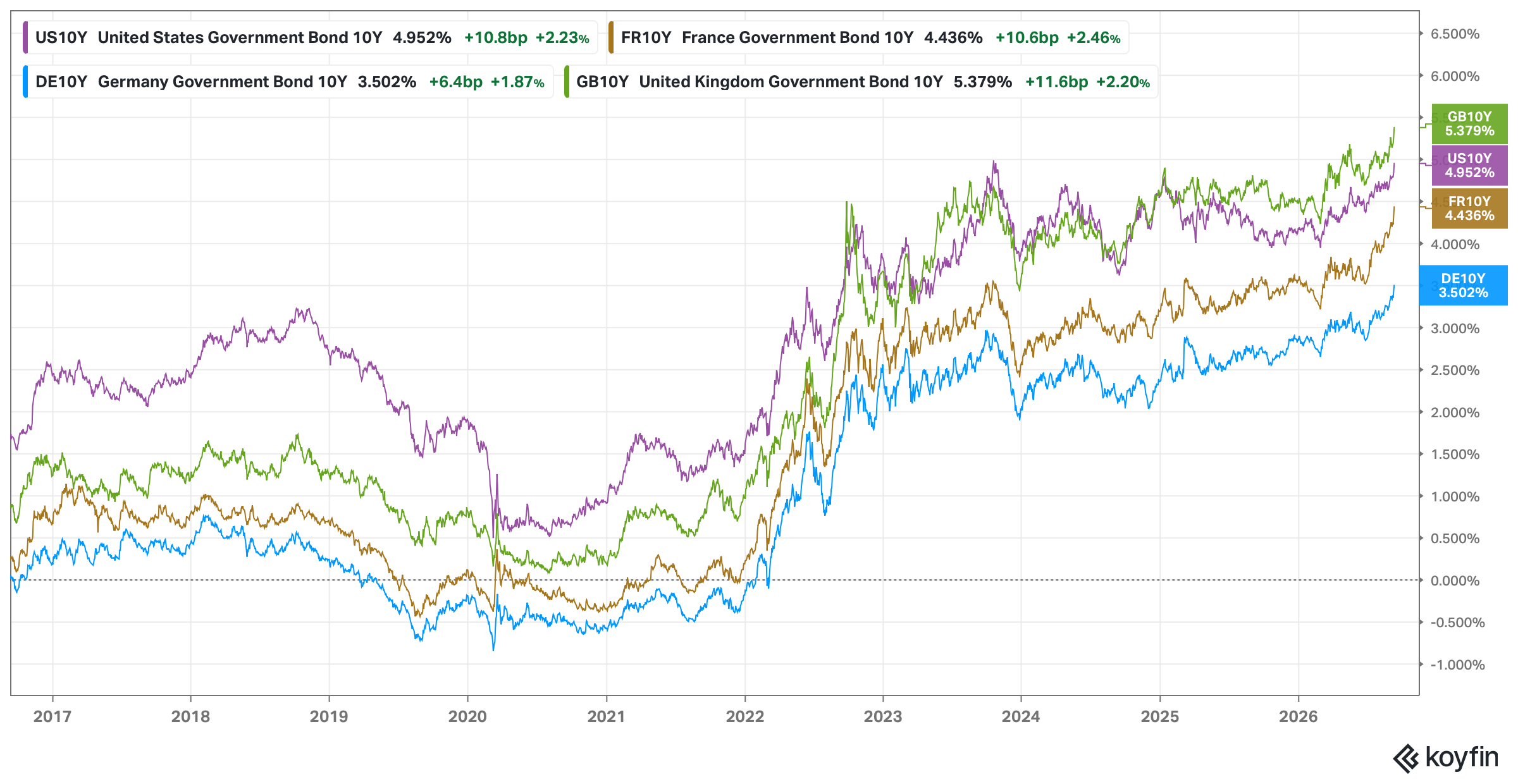
Four countries, a shared direction. Ten-year government bond yields (%) in the supplied Koyfin snapshot, dated 10 September 2026 in the accompanying notes. These are yields, not investment returns. Source: Koyfin / supplied chart.
A bond is a loan with a price tag
Buy a conventional government bond and you lend money to the state. It promises interest payments and repayment of face value at maturity. You don't have to wait that long: bonds trade in the open market.
That market price changes. The promised payments on a fixed-rate bond generally do not. If new bonds offer better returns, an older bond with smaller interest payments becomes less attractive. Its price must fall to tempt a buyer. This is why bond prices and yields move in opposite directions. [1]
If a bond's interest payment stays fixed but you pay less for it, you receive more income for each dollar invested.
The rising lines in the chart show higher yields at lower market prices, not gains for bondholders. The US daily move of 10.8 basis points is a 0.108 percentage-point rise in yield, not a 10.8 per cent return.
Why investors are asking for more
A ten-year loan exposes a lender to a lot of uncertainty. Inflation can erode the buying power of future payments. Interest rates can rise, leaving an existing bond looking less competitive. Governments may also need to sell more debt, competing for investors' money.
A long-term bond's yield reflects two things: where investors think interest rates are heading, and the reward they want for the risk that rates turn out differently. That extra reward is called the term premium. Economists estimate it using models; it cannot be read directly from a market price and can sometimes be negative. [2]
That's why a ten-year yield can move before a central bank changes rates: markets keep revising what they expect next, and how much uncertainty they're willing to accept.
Why conflict can hurt "safe" bonds
During a crisis, investors often buy government bonds for safety. That pushes prices up and yields down. But a conflict that disrupts energy supplies can create a competing force: higher inflation.
More expensive oil raises fuel and transport costs. If those increases spread through the economy, central banks may keep interest rates higher for longer. Investors can then demand higher bond yields, even while worrying about the conflict itself.
Energy disruption -> higher costs -> inflation concerns -> expectations of higher interest rates -> pressure on bond prices
This is playing out now. The Associated Press reported that the European Central Bank raised its benchmark rate by a quarter of a percentage point, to 2.50 per cent, on 10 September, as the Iran war drove energy-related inflation pressures. [3]
The shared rise in the chart is consistent with an inflation and interest-rate shock. It does not prove that energy explains the whole move, or that the ECB's decision caused US yields to rise.
Two routes to higher bond yields
Both routes put bond prices under pressure and push yields higher.
- Households: new mortgages can cost more.
- Businesses: new borrowing gets pricier.
- Governments: interest costs rise as debt is issued or refinanced.
A possible feedback loop: higher government interest costs can widen deficits, creating a need for more borrowing. This is a risk, not an inevitable debt spiral.
A force in the other direction: investors seeking safety can buy government bonds, supporting prices and lowering yields. The stronger force depends on circumstances.
A simplified map of possible mechanisms, not a measurement of what caused the September move. The channels can overlap; their strength varies. Treasury buybacks can add demand for bonds, but do not remove the underlying need to borrow. The consequences for investors and borrowers are explored in Part 2.
Sources & reading
Market figures refer to the supplied Koyfin snapshot dated 10 September 2026 in the accompanying notes. They are not live prices.
- TreasuryDirect: Understanding pricing and interest rates — the relationship between a bond's price, interest rate and yield.
- Federal Reserve Bank of New York: Treasury term premia — expected interest rates and the modelled term premium.
- Associated Press: ECB raises interest rates to quell energy-fuelled inflation, 10 September 2026.